Phil Collins singing "Turn It on Again"
“I… I… IIIIIII!!!!”
Source: Genesis official YouTube channel

One bane of every writer, including this one, is watching how you start sentences, particularly in first person. I don’t mean sentence fragments. A newer editor and writer complained about that, to which I said, “I not only use them all the time, I once edited a book written almost entirely in fragments.” He was horrified, but the book, a two-week copy edit, would have taken more like six weeks or had to have gone back to the author for another trip across the keyboard. But there is one error I flag because, as a writer, I know it’s invisible during the creation process but will drive readers batty.

That opening word on every sentence in a given paragraph. I mentioned first person up front because it’s also the hardest to avoid, hardest to edit, and hardest for the writer to fix if it goes beyond the limits of a copy edit. Unless we’re in a developmental edit, where we’re already killing darlings and moving scenes around, I don’t rewrite. That’s not my job. My job is to flag where the prose needs tightened up. Even in a developmental edit, I’d flag a troublesome paragraph with a comment. (Thank you, Word. Thank you, Scrivener. Thank you, Google Docs.)  In first person, it’s hard not to start every sentence with “I.”

“I” is the most common word in a first-person narrative. The narrator is telling you a story, and the narrator, more often than not, is the protagonist–or thinks they are. So, you can have two or three paragraphs where the narrator starts every single sentence with “I.” Also in first person, it’s the hardest to fix. If it’s too onerous, I highlight and comment that it needs reworded. I can just see the writer cringing as they read that note. I can also hear them going “D’oh!” As a writer, I can relate.

But “I” is not the only offending word. “You” (usually in dialog), “he/she/they,” and, to my surprise, “the” are frequent offenders. And this frequently gets through a couple rounds of revision before I even see it. Like I said, it’s invisible when you’re writing.

Two instances where I won’t flag anything. The first is across paragraphs. If you use editing tools like I do (because having a digital flashlight helps considerably) you notice apps like ProWritingAid don’t like multiple sentences starting with “I/You/The/etc.”  regardless of paragraphs and dialog. The trouble is the reader doesn’t care. Even with action beats and dialog tags, everything inside the quotation marks is a new thought. And everything in other paragraphs should be separate thoughts. This happens, then this happens, then someone says this. So I ignore it. If it bugs the writer, then the writer can fix it.

The other case is when it’s deliberate. Someone is hammering a point home. “You never pick up your laundry. You never take your dishes to the sink. You never put the toilet seat down. You are a slob.” (Scenes from my first apartment. I wonder how that girlfriend is doing these days? Also, I do put laundry away and take dishes to the sink. Um… Maybe I’ll save that story for the new TS Hottle Substack in a couple of weeks. 😉 ) There, it’s deliberate, almost poetic, and probably humorous. I know some editors who will flag it because they think it’s their job to apply rules instead of make the prose more readable. That’s editing for editing’s sake, and frankly, no one knows or remembers the editor. They do know the writer, who has the power of the almighty Stet when doing revisions. (Incidentally, I did precious few stets with Chris Rhatigan, my predecessor at Down & Out, and Dawn Barclay, now my colleague at that vaunted crime press. We all have similar approaches. And as a writer, they get me.)

A particularly aggressive editor might flag everything. This is not malicious, and if you think that red ink is a stab at the soul, think again. It’s to make you, the writer, think before you stet. I’ve only met one editor who got overly aggressive with applying rules (and his show-don’t-tell example was the most absurd abuse of that chestnut I’ve ever seen), but unless they are rookies, those editors are few. The right editor won’t care (much) about the writer’s feelings, but they damn well better think of the reader, who’s going to be buying your prose. And sometimes, that means breaking the rules for readability.


*With apologies to Adrian Belew
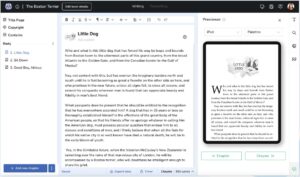
Atticus screenshot
Source: atticus.io

I recently added formatting to my list of services. I’ll talking pricing and why certain types of projects are more expensive down the page a bit. But for now, I’ll talk about how I format.

I use an app called Atticus, which is web-based but functions like a desktop app. In Windows and on Macs, it behaves more like a phone app, which is really a harness for web data from a specific source. Think about how you manage your mobile phone account. It’s like that. Atticus was created in response to another great formatting product, Vellum, which is strictly a Mac product. Unlike writing and editing tool Scrivener, which started out on the Mac OS X platform because its user base would be more receptive, Vellum prefers to stay inside the late Mr. Jobs’s walled garden.  So for some people, the 90s never ended despite the two largest computer companies in the world abandoning hacked versions of the Xerox GUI-based OS from the early 1980s. (Yes, that classic Mac and Windows 3.1 are the exact same thing. Jobs just had better aesthetics than Gates, who liked to use his customers as unwitting beta testers.) So, with a need for a Windows-compatible solution, they created Atticus. 

Vellum screensho
Source: vellum.pub

I’ve had the app for about two years now, and it gets better every time I run an indie-pubbed project of mine through it. There are differences between Vellum and Atticus, but the two compare rather nicely. Atticus wants to also be your writing software, though that piece is neither a priority nor really matured yet. Seems developers are aware those of us using Word to write and those in the Cult of Scrivener will simply rise with one voice and yell, “Get off my lawn!” To quote that fine, upstanding paragon of the flower child generation, Chuck Napier*, I reach, brother. I reach.

But since Atticus and Vellum are compatible products that have earned their loyal following, let me speak on behalf of both my fellow Atticus formatters and our Mac-based brethren using Vellum: For the love of all that is holy, profane, and even mundane, please stop sending us manuscripts setup like we’re going to the printer!

I’ve gotten better about asking editing clients not to do this. I make an exception for my primary client, Down & Out Books, since they like to partially format before they set me and my fellow editors loose on it. We’ve grown used to this. It also helps them spot formatting issues before they put the final product together.

But how, oh, pompous IT guy who apparently can write, edit, and format, are we to send you a manuscript?

Simple. Many newer writers (of which I was one once upona) assume they’re responsible for the page headers and numbers. That’s actually the last thing that should happen because… You’re either sending it to a formatter or running it through formatting software yourself. And those nifty packages I just told you about? They do that for you. Where do you want your page numbers? Do you want them or a header (Author name on one page, title on the other.) at the beginning of a chapter? Do you want all your chapters to start on the right-hand side? (My personal preference.) What font do you want to you use? Most of us who format will ignore the ebook formats, but print has a lot of work. In print is where headers, scene breaks, and chapter titles (even when it’s just Chapter 1, etc.) come into play.

A few things that will make your formatter’s (or yours if you DIY it) easier:

  • We don’t need the page numbers yet. We just need to know if your story begins on Page 1 or whatever page the prologue or Chapter 1 starts on. Every author and every publisher is different. Again, this only comes into play when you’re independent or a really small press. 
  • Make your chapter titles Headers (as in the paragraph styles, not an actual page header. Confusing, but different.) Atticus and Vellum look for those.
  • This is more for anthologies and collections. For most projects, I will charge a flat $75.  If you want the story title in the header and/or the author name for each story, that will cost you a little more. I can’t speak to Vellum’s capabilities (and any Vellum users, please chime in. This is useful information for potential clients, not just mine.)  Currently, Atticus does not do separate titles and writers throughout a single book. So that will have to be done in Word, requiring section breaks, really annoying header management, and trying to get the correct trim size in PDF. (Scrivener users, please chime in as Scrivener has awesome formatting capabilities as well.)
  • Ask if your formatter will do your cover. I send people to GetCovers.com after I have a print page count. That doesn’t happen until after formatting.
  • Scene breaks. The standard is all over the place, but both Atticus and Vellum give you the option to use an image for your scene breaks or even a blank line. However, it has to know where to break them. Your editor or publisher wants “#” centered  to break scenes. Your formatter wants “***”, also centered. Be consistent, because we can always search-and-replace.

*Not only did Chuck make a career playing hard-ass military types, but he famously was a space hippie in the original Star Trek. Chuck looks like he was having fun. Nimoy and Shatner look extremely annoyed in that episode. I reach.

CrutchesA while back, I wrote about crutch words and the approach I took to weeding them out. A working editor is a work in progress, and I am no exception. I developed a four-word approach to “Words That Must Be Scrutinized!!!” (Cue really loud gong.) The offending words are “suddenly,” “just,” “very,” and “that.” Yes, “that” can be a crutch word. The story analysis project I’m finishing up as I write this also abused “and.” Mind you, the author is an admitted first-time writer who does not speak US English trying to write in US English. English as a first language is weird enough. I get headaches rendering an alien language into Elizabethan English to convey excessive formality, so I get it.

I’ve modified since then. I don’t do a “that” check anymore. That is used more often legitimately than as a crutch, so you could easily get a thousand instances of it in a long manuscript. ProWritingAid is pretty good at flagging it when it’s used to join a long sentence together. Never say “The fact that…” Just say “The fact…”

But I got so zealous about purging and replacing “that” with “who,” “how,” and “which,” that I got pushback from both author and publisher. (The author turned around and wrote a blurb for my editing work, so it’s a case of making good better.) So now, I look to see if “that” is unnecessary in context. 

I still go after “very” and “suddenly.” In fact, I get mad if I can’t delete “suddenly.” “Just” remains a sticking point. It’s the most abused of the three. One writer, who’s been around for decades, had seven instances on one page! It is a monumental pain in the ass to weed those out, and in a couple of instances, I had to leave two on the page. But it’s a crutch word.

Once upona, I used to go after “should” because Bestelling Authorâ„¢, who had a writing course®, said it’s a bad word. Probably is. Too many “shoulds” on a page will annoy the reader without them realizing why. I quit doing that because it ended up giving me stilted prose in my own work and annoyed an editing client early on. This is also I don’t do writing books. I publish independently or small press, so until they start showing up on bestseller lists or I have a waiting list for my services, I’m not going to be a shill and pretend to know more than I do. Here, I’m sharing what I see on the job. 

So it’s “very,” “suddenly,” and “just.” I’ve added one more because I caught it in print in one of my own books: form. Why is “form” bad? It’s not as long as you are filling out a form, you’re admiring that other person’s cute form, or your mother-in-law, in her rage, assumes her demon form.* But every so often, in the heat of writing, we type “form” instead of “from.” It’s something that even an editor can miss. We’re not perfect, and two errors can hide a third in plain site. So I check all the instances of “form.” 99% of the time, they’re all correct. That remaining one percent usually sees a character bopping out to Sinatra singing “The Girl Form Ipamena.” So, yeah, the writer probably wants to know about that typo.

As I said before, different editors have different approaches. Some will zap anything with an “-ly” in it. Some have long lists of words they never want to see in a manuscript again. Others just read it in context and decide if it sticks out like a sore cliche.  

* Actually, my mother-in-law is a sweet 80-year-old lady. My ex-mother-in-law is a nice Mormon lady with a decidedly un-Mormon sense of humor who definitely gave it to her daughter. Who happens to be my favorite ex. I’ve married often. And well. Not many people can say that. 

Robert Plant and Jimmy Page in concert.
Led Zeppelin

Following on last week’s column (or was it this week? I was late getting it out.), the word “was” and its close relatives bring to mind the core reason I wrote about it last week. It robs the prose of immediacy. Let’s face it. If you’re a writer in today’s world, especially a fiction writer, you can’t afford to lose immediacy. People have short attention spans. If someone has been sitting down to read your work, you’d better keep their attention before Netflix drops the final season of Stranger Things or the Kardashians do something they think is noteworthy.

First, let’s look at the three main verb tenses in English. And thanks to eslgrammar.org for the assist. They have a handy page to look this up.

Writers in rough drafts, including those two hacks TS Hottle and Jim Winter, tend to use what’s termed past continuous when writing action. Most prose is written in past tense. They often write past continuous to convey action. Only, to the reader, it just looks like passive voice. 

“He was walking into Clarksdale.”

Robert Plant gets a free pass on that line because he needed to keep time with Jimmy Page’s chords in that song. You, gentle reader, who hope to have gentle readers of your own, don’t get a pass. Unless our intrepid Clarksdale-bound hiker is interrupted as he’s coming into town, the line should be “He walked into Clarksdale.” Simple. Short. Declarative. Hemingway would be proud. And he would know. Even Hemingway’s passive voice reads like action. (That’s another post.)

So what are the tenses?

There are three main ones: Past, present, future. If you’re writing time travel, you’re on your own. Even Douglas Adams and the writers of Doctor Who make fun of those who try to invent tenses. 

Then we have the continuous tenses, indicating ongoing action by the subject. I was walking into Clarksdale. I am walking into Clarksdale. I will be walking into Clarksdale. In everyday speech, this is fine as long as you can be understood. In prose, I read it aloud and look at the sentences around the offending phrase. As I said in my last post, it’s fine if our intrepid walker does one thing and is either interrupted or does something else as well. If not, well then, he walked into Clarksdale. This assumes, of course, the main action will be happening in Clarksdale (and without that clunky future continuous phrase, which has damned few use cases.)

Then we have the perfect tenses. The first two almost always indicate past events. Past perfect (“I had walked into Clarksdale.”) and present perfect (“I have walked into Clarksdale.”), indicating the speaker or point-of-view character has walked into Clarksdale at least once. Future perfect means the speaker or POV character will walk into Clarksdale at least once before a future point in time in question.

But wait! There’s more!

Past/present/future perfect continuous!  “I had been walking into Clarksdale,” meaning this was at some point in the past a frequent occurrence. “I have been walking into Clarksdale,” meaning this is something ongoing. “I will have been walking into Clarksdale,” meaning this is something likely to occur regularly or repeatedly in the future.

Again, you need a good reason to go with this. A lot of writers use the continuous tenses (both basic and perfect) thinking it conveys action. Unfortunately, there’s that word “was” (or “is” or “are” or “will be.”) Any time the reader sees that, the brain fires up “Passive voice!” and passive voice is to be avoided. (Not always, but a future post will be written about that.) The best use case for continuous is when the phrase is followed by “when.” “I was walking into Clarksdale when…” Then the action is disrupted. Which basic past/present tense doesn’t convey very well.

The only other time you should really use it is when you need to line up your rhythm with Jimmy Page’s playing. Then you’re going to send your old pal Tom tickets as I’ve only seen two Yardbird guitarists live. One has passed on, and the other has turned out to be an idiot. Unfortunately, Pagey is largely retired, so a pass to see him live would be greatly appreciated.