The bulk of what I edit comes from a publisher. So it stands to reason each writer, regardless of flaws, knows how to write. Now, how well they write is up for some debate, and that includes your humble narrator. Self editing, of course, is a tricky skill to master. It’s why I’m a fan of Stephen King’s process, where in the rough draft gets shoved into a drawer or dark corner of the cloud for two or three or six months. That masterpiece you wrote in the heat of the moment suddenly looks like the literary equivalent of a Very Special Episode of Hoarders. 
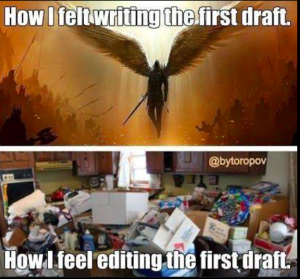
 

But you should know how to write, even in that messy, everything-but-the-kitchen-sink first version of the story you’re writing. I mentioned on my author Substack that I just started a short story I knew was already bloated because it takes too long to wade in. Of course, I’m GenX. Typewriters and dedicated word processing machines were still a thing when I began to work on my craft. I know one Gen Z writer who says he doesn’t do drafts. He just revises the existing original. He’s about fifteen years younger than me and started writing probably on Word Perfect or even the early Microsoft Word. Which means we’re both old enough to have owned cassettes for music and don’t cotton to these fancy, newfangled apps like Scrivener. (Scrivener has been around long enough to cultivate quite a few “Get off my lawn!” types among its fan base. Welcome to the geezers club, Scrivenites. The guys still using IBM Selectrics will be tending bar this evening.)

“Well, gee, Hottle. Are you going to get to your point?”

Now that the bush has been thoroughly beat around, yes.

This column, and dozens of others just like it, are about beating a manuscript into submission. (For submission, though no pun was intended.) Some time back in the 2010s, all the writing advice became about flogging books on Kindle, how to crank out 10,000 words while walking your dog, taking a shower, or getting a root canal. (Pro tip: Dragon Anywhere does not understand WTF you’re saying when a dentist is ripping bone out of your mouth.) None of it was about the joy of writing, why we do it, what drives us to sit at the keyboard and make stuff up.
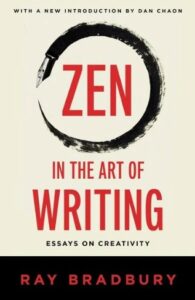
Zen in the Art of Writing by Ray BradburyRay Bradbury wrote a book about it. He came up in the age of pulps. His best known science fiction novel, The Martian Chronicles, was welded together in outline form almost on a dare from his editor (who wrote him a check the next morning.) Bradbury knew he wanted to write from earliest childhood. I’ve heard tell of writers whose parents discouraged them. One gent I used to know took beatings over it. (He’s old enough to be my father, so put that into generational context. My dad transitioned from spanking to the time-out because the latter really pissed off my brother. I digress. Again.) No, Bradbury collected memories. He wrote down lists of nouns that triggered those memories. And he talks to his characters. He actually will chat with them, listen to them. It’s how he adapted Fahrenheit 451 and Something Wicked This Way Comes for stage and screen. And I’ve noticed movies based on Bradbury’s work tend to hew more closely to the original source than that of other writers. Stephen King comes close, even when a director “has their own vision” (Shut up, Stuart Baird!), though the director of The Outsider needs to apologize for trying to excise Holly Gibney from that story. 

Bradbury approaches life as one long journal entry. Something happens to him or around him, and he knows an idea from it won’t emerge for years, sometimes decades. It’s obvious to anyone who’s read Something Wicked This Way Comes. And if you read between the lines, you can see an homage to Sherwood Anderson’s Winesburg, Ohio in The Martian Chronicles. And, I suspect, shades of Stephen King’s Castle Rock, too.

There is actually no Zen in Zen in the Art of Writing. Well, not until the end, with the essay that gives the book the title. This is Ray Bradbury telling you he’s not a science fiction or literary god but just a kid from Waukegan, Illinois, who got to make stuff up for a living. One suspects he’d have done it whether he got published or not. Writing is, after all, an unstoppable madness for many. Including Bradbury.

Writers get a lot of inspiration from music. From other writers. From poetry. It’s only natural they would want to quote it.

But can you?

Short answer: No. Unless it’s public domain, you need the creator’s permission. (Looking at you, Mark Zuckerberg! Stole two of my books to train his crappy AI. That’s another rant.) 

Long answer: Sometimes. Let’s be honest. Creators should be paid for their work. So if you’re lifting lyrics from Led Zeppelin (a band that knows a thing or two about having to settle plagiarism lawsuits, both as defendant and as plaintiff), Mr. Plant is probably going to send his lawyer after you. Or maybe not. Half a line from “Stairway…” is probably not going to land you in court. On the other hand, if you base your epic fantasy on “Achilles Last Stand” or “Battle of Evermore” and quote whole snatches of the song, Messrs. Page, Plant, Jones, and the widow and son of John Bonham are going to want either a cut of your royalties or a licensing fee. Now, if you use those songs as jumping off points (“Achilles…” itself comes from The Iliad, public domain since the Roman Empire overran Greece), no harm, no foul.

Similarly, trademarks can get dicey. When does a pop culture reference turn into trademark infringement? Also depends. In No Marigolds in the Promised Land, I referred to a type of rolling drone as “daleks,” with the narrator wondering where that name came from. At the time, the BBC was the sole arbiter of the Doctor Who trademarks. Their tendency was to let it be as long as these were balky robots and not the encased aliens with a speech impediment. Also, without thinking, I overused a Star Wars reference that went from something that would give George Lucas a chuckle to bringing a giant mouse in dark glasses and his giant duck enforcer to my front porch armed with brass knuckles and a cease-and-desist order. That got purged. The daleks?

I was advised to curtail them by an editor I knew, though I’ve seen references to Tardises (Tardii?) that clearly were not the multidimensional phone booth David Tenant uses to commute to work. I left a few references in, but regularly call them trashcan drones because, well, canonical Daleks look like giant garbage cans. So it’s likely anything so shaped and earning a name from a centuries-old pop culture reference is likely to do also look like a trashcan.  And it’s obvious they’re not out to ex-terminate! Ex-TERMINATE!

Even Tolkien might come after you. Lord of the Rings, still copyrighted in 2025, has a lot of trademarks. I can name a mountain chain “Misty Mountains” on a distant planet because CS Lewis’s language-obsessed buddy wasn’t the first to use that name, but deciding a desert region earned the literary reference name “Mordor” would not have flown. (Yes, I thought about it. Then I decided I knew nothing about Amargosa’s deserts as they didn’t do anything for the story.)

A friend of mine, when he sold his first novel, quoted song lyrics all the way through, usually to start chapters like Stephen King occasionally does. He got a surprise from his publisher when he received marching orders to secure permission from each of the songwriters. Most of them agreed, some tickled an author remembered them. (Pro tip: NEVER assume this. ALWAYS ask. This is NOT fair use. Ever.) Then he got a call. “Why do you want to use the song?” “Huh? Who is this?” “Neil.” “Neil who?” “Young.” “Yeah, feck off, Martin. I don’t have time for your jokes. I got an early class tomorrow!” Neil called back. They actually had a good conversation.

On the other hand, that same writer edited an anthology he invited me to. I wanted a character to paraphrase the a line from U-2’s “Hold Me Thrill Me Kiss Me Kill Me.” Would they care? “Not if you give them $200,000.” My house at the time was worth less than half that. (Mid-2000s, so… Cheap.) That was a hard no.

But paraphrasing is a way to get around quoting a song without stepping on the copyright holder’s toes. I’ve seen where AC/DC “thundered about a railroad track.” Most of you know what song that is. The rest can easily plug “AC/DC” and “railroad track” into Google and find out. Go ahead. You’ll be thunderstruck. 

A handful of bands and singers will allow snatches of lyrics to be quoted. You’ll need to get written permission, if only to cover your butt. And not every band will rush to your defense if they’ve sold off their catalog to an unscrupulous publisher. Yes, them that own the Beach Boys’ music managed to get Mike Love and Brian Wilson to team up, at least on Twitter, as they trolled them over a lawsuit against Katy Perry for her own “California Girls.” (If you sue over your own IP, and the creators flame you on social media, you can pretty much kiss your case goodbye.)

Now, what about character names? I get dragged by betas (who should know better by this point, having read the entire series) over a diminutive engineer named “Peter Lancaster,” with a rather familiar accent and libido. (Connor Duffy of Compact Universe fame constantly asks him how he hasn’t been court-martialed yet.) Again, this is suggestive of Tyrion Lannister and the brilliant actor who plays him, Peter Dinklage. However, it just made the character come together. But what if I named a character “James T. Kirk” or “Anakin Skywalker”?

Yeah, do that and you might start getting some rude letters from high-priced attorneys for Paramount or Disney. They get a bit worked up over that. (Lucas, however, still enforces the parodies-are-funny rule despite selling Star Wars to Disney. Suck it, Mickey.) You’ve probably met a James Kirk, so you might be able to shrug and say, “Well, I never watched Star Trek.” On the other hand, a world-weary detective named “Jim Bond” might get annoyed with all the Sean Connery imitations he has to put up with. (“Oh, wow. My girlfriend’s name is Moneypenny. I’ve never heard that before. Well, not counting the thousand times just last week.”) There, it’s a pop culture reference that likely will not ruffle the feathers of the Fleming or Broccoli families. (No one cares what Kevin McClory’s family thinks, since they sold Blofeld to Eon and, subsequently, Amazon.) But anything named Skywalker tramples on well-established trademarks. And we all know the Mouse is already displeased with Winnie the Pooh horror films now that their original copyright has expired. 

In the end, use common sense. You can get away with references to Twain, Shakespeare, or Dickens because they’re public domain. Your main concern should be how the reader will interpret it. On the other hand, Sherlock Holmes is also public domain as far as copyright is concerned, but the Doyle estate still owns the trademarks. That’s right.  They can still sue you if you still cross a line. You can bet they had a hand in the making of Robert Downey Jr’s turn as Holmes, Sherlock, Elementary, and most recently, Watson. 

And really, it’s someone else’s work. Orcs may not be original to Tolkien. Per Tolkien himself, it’s from Anglo-Saxon and appears in Beowulf.  Uruk Hai might earn you a nastygram from Christopher Tolkien’s solicitor. Similarly, Starfleet (Jimi Hendrix’s references notwithstanding), Jedi, and Brown Coats will get you in trouble. 

So, if you’re wondering if it’s fair use, if you’re describing something in someone else’s work or paraphrasing lyrics, yes. It is. If you’re lifting characters, prose, or lyrics wholesale from something where the creator hasn’t passed away in the last 75 years, you might want to rethink that.

Wadded paperPublishers, especially those in small press, are traumatized by how too many manuscripts come in. Goofy fonts. Weird margins. Author never read the guidelines. (Pro tip: If you’re asking someone to sell your work for you, they make the rules on formatting. End of discussion.) But it gets witchy for editors, too.  However, I get it. Writers have so much anxiety about query letters (Maybe agents need to quit talking so much about that. All they do is induce performance anxiety.), acceptance and rejection, and getting seen! And if it’s a first-time novelist, and you’re the lucky editor who gets to read them, you’re reading someone’s baby!
Do a couple of these things, meet with some success, and you, the writer, slowly learn that the final draft for the freelance editor, the agent, or the publisher is a reprieve from the Thing That Will Not Die. Because that shiny new story is a millstone around your neck a year or two later. And while a lot of writers enjoy working with their editors, opening that Word doc with all the track changes turned on usually results in the writer growling, “Oh, what fresh hell is this?” (Because the Thing won’t Die! You still have revisions. Especially if there’s a developmental edit step.)

But how should the manuscript look when it goes to the publisher, agent, or freelance editor?

Most publishers and agents want a specific format: Times New Roman, 12-point font, double-spaced. There’s a title page with the estimated word count and your contact info at the top and the title and your pen name (even if it’s you’re real name. If it’s a pseudonym, put the pen name in quotes.) halfway down the page. If you are subbing print–rare these days, and thank God for small miracles–pagination on every page following the title page is required. If submitting electronically, don’t paginate. Use “#” for scene breaks. Dedication is optional, as are acknowledgments and about the author, but copyright is not needed, even if you registered it. That will be added on publication.

For freelance editors, it’s even easier. Word, Google Docs, OpenOffice all track word counts, so we just need the title page and your prose. However, same rules apply. Times New Roman, 12 point, and double-spaced. 

“But why don’t you want page numbers?”

Well, unless I’m looking at a hard copy, which I assure you I will not until your tome is out in the wild, I can see the page numbers in the lower left-hand corner of Word. 

“What if the publisher wants something different from what you described?”

That brings me to the most important thing a writer can remember about submitting any kind of manuscript: Read the bloody guidelines! This means you. 

“But I want my book to look a certain way. Why can’t I format it?”

Because your book, even if all we do is move commas around and make snarky comments about something funny you wrote, your manuscript and all its carefully formatted pages are going to get altered. At this point, we, the editors, don’t care. Neither should you. One reason is all those funky things you do with formatting come when it’s time to send the book to press. The formatter does that. (I offer formatting services, by the way, just not while I’m editing the book. One step at a time, kiddo.) We are focused on the prose. How are the words strung together. Do you use the Oxford comma or are you wrong? (Another pro tip: Helpful if you tell me your stance on that before I begin reading your manuscript. The publisher will tell you whether you use the Oxford comma or not. An agent has no business having a position on that for anything but their own writing.) 

Formatting, if I may beat the dead horse, is how the book will look in print. And if you even partially format a manuscript that has, at best, only a beta read or two, you’re wasting your time. Words are going to move around. Besides, the bigger the publisher, the less control you have over how the book looks, what cover you have, etc. Just because you want that chapter to end on page 34 doesn’t mean that will survive even a proofread.

Instead, focus on sharpening your prose. Read the submission guidelines. If they’re not specific, the above–Time New Roman, 12-point, double-spaced–is sufficient, along with a title page (if subbing to an agent or publisher.) That’s all you need. The formatter will take it from their when your editor is finished.

My current project has em dashes in place of quotation mQuotation markarks, which is a challenge. Em dashes (or for the more pedantic, dialog dashes. Hate to burst your bubble, nitpickers, but the readers who pick up on this don’t care. Neither do I.) are generally used in Romance languages like Spanish, Italian, or French. I’m not sure why writers in English–any dialect of English–choose to do this, but then Cormac McCarthy dispensed with quotation punctuation altogether.

But having to adapt to a different style of quoting dialog underscores another issue: You still have to follow the rules of dialog. And to follow said rules, the reader has to know who’s talking and when. Even the great Lawrence Block, whose books taught me to write novels long before Stephen King graced us with On Writing, munged dialog once. If the greats do it, you need to watch out, too.

So, let’s review, shall we?

  • “Said” is an invisible word. It takes less than second for the reader to blow by a “said” phrase to pick up on whose talking.
  • That said, the old chestnut of not using any word but “said” (except maybe “asked”) needs to be put down like Old Yeller. (Um… Spoiler alert?) In an age of audio books, it is absolutely nerve-grating to hear “said” twenty-six times in a thirty-second passage. Yes, you can use mild alternatives like “shouted,” “mumbled,” even “intoned.” Just don’t get fancy with it. There’s a reason more old-school editors insist on “said/asked.” “‘Well,’ he queried” is still bad writing no matter how much you’re bored with “said.” </rant>
  • Action beats are your friend. You don’t have to tag every line of dialog. In fact, don’t. Dialog-heavy scenes have the disadvantage of encouraging “white rooms.” Two characters are talking. Where are they talking? What’s going on? Half the time, it’s just exposition, and exposition is death in our era of short attention spans. Sorry, but that’s the reality we’re working in today. Have your characters eat a salad or lift weights or knit a sweater. Anything to convey where the conversation takes place.
  • When exposition is unavoidable, put the Pope in a pool. This is one of my favorite storytelling tools from Blake Snyder’s Save the Cat. He talks about a movie where a bunch of cardinals have to set up the movie and can only do it through rambling dialog. So the screenwriter put an old man in a swimming pool listening to the cardinals. It takes the viewers a minute or two to figure out the guy swimming is the Pope. They get an infodump, but their attention is held because they’re forced to figure out who’s in the pool. (I loved that so much, I put a character named “Mr. Pope” in a swimming pool in one story. Then I killed him in that same pool in another story. Yes. As an author, I’m mean to my characters.)
  • Untagged dialog: No more than five lines before you insert a “said/asked/pontificated” (Don’t use that last one. The reader will throw your book in the trash, and for good reason) or an action beat. The reader needs to keep track of who’s talking. And so do you.
  • Tagging or adding beats: If two people are in the conversation, unless they are the same gender, get their names out quickly and stick with he/she/they*. Once you’ve established who and what they are, the reader can pretty much follow along. More than one person? Or two of the same gender? You’re going to need to drop names a little more often. 

*The common use of singular they today is not political. It’s the means by which I get to spike the football on a pedantic English teacher’s grave. My favorite English teacher, who just turned 90, would heartily approve.