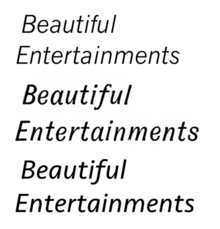
"Beautiful Entertainments" italicized in three different fonts.
CC 4.0 2015 Blythwood

There’s one issue our modern computer-based writing and editing has raised. Italics.

When Word Perfect and the dedicated word processing devices surfaced in the mid-1990s, it solved the underlining problem typewriters could not consistently address. Some of the newer ones had underlining options, including the venerable IBM Selectric. A few die-hards will not give up their magic qwerty boxes until  you pry them from their cold, dead, and lifeless hands. But those of us who learned to type just as Steve and Bill were putting a PC on every desk hated typewriters. And I owned three of them over the years. I moved in with a girl who owned a Canon word processor, and I haven’t looked back since. And one of the things it let me do was italicize.

For the last 30 years, italics have been easy. Ctrl + I or Cmd + I makes all your letters slant. Simple. Maybe too simple. If you have a hammer, everything looks like a nail. Most people know the basic rules: Book titles, album titles, movies, TV series, magazines and newspapers, and works of art. Yes, I’ve been getting The Mona Lisa wrong longer than some countries have existed. Titles of short stories, chapters, TV episodes, songs, poems, and articles go inside quotation marks. (Double quotes in North America, single in UK and elsewhere in the English speaking world. Be consistent.)

That last line brings up another use. Italics can also emphasize a word or a phrase. I generally shy away from that as a writer, but that’s because I also shy away from stage direction. On the other hand, it can reduce use of that annoying punctuation mark, the exclamation point!

The list above comes from Actually, the Comma Goes Here by Lucy Cripps, a quick and dirty style guide for when you dropped your Chicago Manual of Style on your foot and can’t pick it up until the doctor removes the boot. One thing it left off is ship names. That’s right. Star Trek (for some reason, we don’t seem to italicize franchises, just the individual series and movies) is about the starships Enterprise. But that’s led to some bad editing.

I used to italicize class names for ships. Like the last aircraft carrier Enterprise was of the Nimitz class, named for the USS Nimitz. I stopped probably when I also noticed that Star Wars stopped showing up in italics, which was right around when the original movie was renamed A New Hope*. 

But as a writer, I’ve had to smack a couple of editors’ hands. (I’ve had my hand smacked, too. Occupational hazard.) People start italicizing things which they had no business slanting the letters. Specifically, building names, business names, restaurants, theaters. That’s actually a big no-no. And this is not like the argument between people who require the Oxford comma and people who are wrong. You do not italicize restaurant names, theater names, and buildings and businesses!!! Now and forever, world without end. Amen. Shakespeare debuted Hamlet at the Globe Theater, but the Globe Theater does not exist. No. Don’t do that. Ever.

Italics are not as badly handled as apostrophes, commas, or capitals. But they do get abused. Overusing for emphasis is just as distracting as too many exclamation points or bad dialog tagging (“Get out,” she shrieked shriekily.) As with anything, stick to the basics and use in moderation.

*The proper way to watch A New Hope is to watch Rogue One, then immediate jump into A New Hope, and finishing on YouTube with Robot Chicken‘s “Go for Papa Palpatine” bit. Then, you shall know what the hell an Aluminum Falcon is.
An apostropheThanks to clickbait and social media, use of the apostrophe (or “sky comma”) is a lost art. The most common (and often ridiculed) error is, of course, your/you’re. When you’re typing at a million miles an hour and want the words down, it’s easy to “hear” a word and pick the wrong spelling. For all the jokes about your/you’re, it’s something a ninth grader doing a proofread of your manuscript can spot. Assuming that ninth grader doesn’t believe texting should be the basis of grammar. Spoiler alert: It shouldn’t. k thx bye!
For the most part, people get contractions right. “He’s,” “they’re,” and “can’t” are all common examples. Frequently, I do see the apostrophe left out of “can’t.” In a manuscript, I’ll flag it. That’s what I get paid to do, among other things. Reading it, it’s not the most egregious apostrophe error out there.

Where do we get it wrong? Possessives. People can’t seem to wrap their head around when an apostrophe should or should not use it to denote possession. After all, we use his/her/their for third person possession. Where’s the apostrophe? Pronouns, aside from being the most monumentally stupid thing for politicians to whine about, are their own thing with their own rules. No formal name or specific noun denotes the possessor. Except…

There’s that pesky pronoun “It.” “It’s” is not possessive but rather a contraction for “It is.” When, as a pronoun, “It” possesses something, then you write “its,” no apostrophe. The easiest way to remember it is pronouns don’t use apostrophes for possession: Mine, our, your, his, her, their, and its. 

Now, let’s talk about where people really grind my gears: Slapping an apostrophe in to indicate plural or omitting it to indicate possession. STOP DOING THAT!!!  You know I’m worked up about that if I use three exclamation points after a sentence. That, in and of itself, is extremely bad grammar. So hopefully, I made my point.

Every so often, I’ll see a sign as I’m driving along or even online where someone wrote something along the lines of “Drink’s and Sandwich’s.” One had it as “Johnnys Bar.”

If you needed more proof civilization is in decline, there it is. It’s “Johnny’s Bar” and “Drinks and Sandwiches.”

Worse, some people labor under the delusion that the apostrophe goes before every “s” at the end of a word, especially if it’s a plural. STOP DOING THAT!!!

Now, the question on everyone’s mind once they realize how easy apostrophes are: What if a name or noun ends in an “s”?

Well, as we say in SQL Server work, “It depends.” This is one where the style guides vary wildly. Are we going to Charles’ house or Charles’s house? The Chicago Manual of Style says “Charles’s house” while the AP and various British guides suggest “Charles’ house.” Even Jess Zafarris and Rob Watts of the Words Unraveled YouTube channel can’t agree. Rob himself, a former BBC reporter now living in Germany, says he’s been forced to change with every style guide his work requires. And if it’s “Charles’s,” do you pronounce that second “s”?

Here is TS’s guide to the sky comma when it comes to nouns ending in “s.” It’s possessive, so use “‘s” at the end. However, it’s an S, followed by an S. You don’t have to say it out loud. This is what I learned in school, what a potential agent told me to use (I laid down the law on the Oxford comma, but she was in agreement it’s mandatory. Get over it.), and ultimately, what the Chicago Manual uses.


Cold beerBack in the old days, when my dad would take us all out in his LaSalle to the five-and-dime for a grape Nehi while Rudy Vallee warbled “Whole Lotta Love”… Um… Wait. They didn’t make LaSalles when my dad was born, Rudy Vallee had given way to big bands, and my earliest memory of a new song was “Something” by the Beatles when I still had not known the horror of kindergarten. Let’s start again. Back in high school, before the age of word processors, cloud storage, and AI, we were taught to write in drafts. In fact, my favorite English teacher Mr. Murphy (still going strong at 90!) told us to write out the first draft by hand before sending it across the typewriter.  Subsequent drafts, after chopping up with a red pen*, were to fix flow, spelling, typing, etc. If the truth be known, I was 30 before I could type, and by then, word processors and computers were a thing. 
But I stuck with the draft concept, though I rarely wrote longhand. My wrists don’t like it. And starting with the original Mrs. Hottle’s Canon word processor, the concept of typing all drafts took off. I no longer had to worry about margins. You could set a default font. You just typed, then saved to disk. Then came the PC and Microsoft Works. Then Word Perfect. Then Word. Many took it a step further with Scrivener. I’ll talk more about the various tools later.

As I started getting into professional markets, I met a writer named Dave White, now a school teacher in New Jersey. At the time, Dave was a grad student and just getting started as a novelist. Dave decided to abandon the draft concept. Everything is stored electronically, so you’re not rewriting (except when you are. Then you’re overwriting the original or copying and pasting. Or cutting.) So why make multiple files?

It’s a fair point. He’s been a more successful novelist than I’ve been, and, most importantly, the system works for him. Yet I still do drafts despite working in IT for [mumble mumble] years. Why?

Versioning. As Jim Winter, I wrote Holland Bay over a 12-year period, starting with a 105,000-word first draft that did not have a minor character who just had to spin up their own subplot. I didn’t so much finish the draft as stopped when a couple of the main characters finished their arcs. Additionally, I make much of how this series was inspired by 87th Precinct and The Wire. Rereading it, I realized at least two scenes were inadvertently copied from The Wire. You will never read that draft unless my family does something stupid like file my drafts with Wilmington College or my old high school. (Please don’t do that.) The second draft, while still considerably different, looks more like what you would buy today. But not entirely. Some point-of-view characters had to be pared down, extraneous scenes cut. And then an agent looked at it. She asked for a rewrite. Then I tweaked it to run past a Big Five publisher. Then Down & Out Books had some changes. All these versions are different files. Why? 

I work in IT. In fact, I work in software. I’m of the mindset that every version of something should be backed up so it’s available if you scrap a new version. Believe me, in both software and writing, that’s a huge concern. Now, I may be splitting hairs. If you came up when PCs were a thing, you probably back everything up. In fact, you likely store it in the cloud. Is that drafts? Well, most of us who do actual drafts are a bit more systematic about it.

As an editor, I receive manuscripts that are labeled “v03,” which means Down & Out went back and forth with the author before sending it to me. Plus they send me partially formatted manuscripts. I always keep the original version, whether it’s from a publisher or a freelance client, and make a copy labeled “_edited.” That’s both a signal to the writer this has been worked on and gives me a fall back in case something goes horribly wrong.

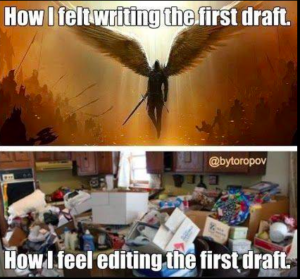
It all goes back to the old adage “Don’t fall in love with your first draft.” Sometimes, someone turns in a clean draft, and people like me just move commas around. But normally, a rough draft looks just like that. Rough. Have a system for the revisions. And stick to it.


*A rather pretentious roommate a former spousal unit and I had protested it was a blue pen, and we were not aloud to argue because she edited. Badly. And every agent, editor, and writer I’ve spoken to since has said, “Red pen.” Blue was for making photocopies in an age when the copier couldn’t see blue.